 Add to Chrome
 Add to Firefox
 Add to Edge
Ψ-Map: Panoptic Surface Integrated Mapping Enables Real2Sim Transfer
Apr 13, 2026
Open-vocabulary panoptic reconstruction is essential for advanced robotics perception and simulation. However, existing methods based on 3D Gaussian Splatting (3DGS) often struggle to simultaneously achieve geometric accuracy, coherent panoptic understanding, and real-time inference frequency in large-scale scenes. In this paper, we propose a comprehensive framework that integrates geometric reinforcement, end-to-end panoptic learning, and efficient rendering. First, to ensure physical realism in large-scale environments, we leverage LiDAR data to construct plane-constrained multimodal Gaussian Mixture Models (GMMs) and employ 2D Gaussian surfels as the map representation, enabling high-precision surface alignment and continuous geometric supervision. Building upon this, to overcome the error accumulation and cumbersome cross-frame association inherent in traditional multi-stage panoptic segmentation pipelines, we design a query-guided end-to-end learning architecture. By utilizing a local cross-attention mechanism within the view frustum, the system lifts 2D mask features directly into 3D space, achieving globally consistent panoptic understanding. Finally, addressing the computational bottlenecks caused by high-dimensional semantic features, we introduce Precise Tile Intersection and a Top-K Hard Selection strategy to optimize the rendering pipeline. Experimental results demonstrate that our system achieves superior geometric and panoptic reconstruction quality in large-scale scenes while maintaining an inference rate exceeding 40 FPS, meeting the real-time requirements of robotic control loops.

JoyAI-LLM Flash: Advancing Mid-Scale LLMs with Token Efficiency
Apr 03, 2026We introduce JoyAI-LLM Flash, an efficient Mixture-of-Experts (MoE) language model designed to redefine the trade-off between strong performance and token efficiency in the sub-50B parameter regime. JoyAI-LLM Flash is pretrained on a massive corpus of 20 trillion tokens and further optimized through a rigorous post-training pipeline, including supervised fine-tuning (SFT), Direct Preference Optimization (DPO), and large-scale reinforcement learning (RL) across diverse environments. To improve token efficiency, JoyAI-LLM Flash strategically balances \emph{thinking} and \emph{non-thinking} cognitive modes and introduces FiberPO, a novel RL algorithm inspired by fibration theory that decomposes trust-region maintenance into global and local components, providing unified multi-scale stability control for LLM policy optimization. To enhance architectural sparsity, the model comprises 48B total parameters while activating only 2.7B parameters per forward pass, achieving a substantially higher sparsity ratio than contemporary industry leading models of comparable scale. To further improve inference throughput, we adopt a joint training-inference co-design that incorporates dense Multi-Token Prediction (MTP) and Quantization-Aware Training (QAT). We release the checkpoints for both JoyAI-LLM-48B-A3B Base and its post-trained variants on Hugging Face to support the open-source community.
M^3: Dense Matching Meets Multi-View Foundation Models for Monocular Gaussian Splatting SLAM
Mar 17, 2026Streaming reconstruction from uncalibrated monocular video remains challenging, as it requires both high-precision pose estimation and computationally efficient online refinement in dynamic environments. While coupling 3D foundation models with SLAM frameworks is a promising paradigm, a critical bottleneck persists: most multi-view foundation models estimate poses in a feed-forward manner, yielding pixel-level correspondences that lack the requisite precision for rigorous geometric optimization. To address this, we present M^3, which augments the Multi-view foundation model with a dedicated Matching head to facilitate fine-grained dense correspondences and integrates it into a robust Monocular Gaussian Splatting SLAM. M^3 further enhances tracking stability by incorporating dynamic area suppression and cross-inference intrinsic alignment. Extensive experiments on diverse indoor and outdoor benchmarks demonstrate state-of-the-art accuracy in both pose estimation and scene reconstruction. Notably, M^3 reduces ATE RMSE by 64.3% compared to VGGT-SLAM 2.0 and outperforms ARTDECO by 2.11 dB in PSNR on the ScanNet++ dataset.
EAG-PT: Emission-Aware Gaussians and Path Tracing for Indoor Scene Reconstruction and Editing
Jan 30, 2026Recent reconstruction methods based on radiance field such as NeRF and 3DGS reproduce indoor scenes with high visual fidelity, but break down under scene editing due to baked illumination and the lack of explicit light transport. In contrast, physically based inverse rendering relies on mesh representations and path tracing, which enforce correct light transport but place strong requirements on geometric fidelity, becoming a practical bottleneck for real indoor scenes. In this work, we propose Emission-Aware Gaussians and Path Tracing (EAG-PT), aiming for physically based light transport with a unified 2D Gaussian representation. Our design is based on three cores: (1) using 2D Gaussians as a unified scene representation and transport-friendly geometry proxy that avoids reconstructed mesh, (2) explicitly separating emissive and non-emissive components during reconstruction for further scene editing, and (3) decoupling reconstruction from final rendering by using efficient single-bounce optimization and high-quality multi-bounce path tracing after scene editing. Experiments on synthetic and real indoor scenes show that EAG-PT produces more natural and physically consistent renders after editing than radiant scene reconstructions, while preserving finer geometric detail and avoiding mesh-induced artifacts compared to mesh-based inverse path tracing. These results suggest promising directions for future use in interior design, XR content creation, and embodied AI.
PLANING: A Loosely Coupled Triangle-Gaussian Framework for Streaming 3D Reconstruction
Jan 29, 2026Streaming reconstruction from monocular image sequences remains challenging, as existing methods typically favor either high-quality rendering or accurate geometry, but rarely both. We present PLANING, an efficient on-the-fly reconstruction framework built on a hybrid representation that loosely couples explicit geometric primitives with neural Gaussians, enabling geometry and appearance to be modeled in a decoupled manner. This decoupling supports an online initialization and optimization strategy that separates geometry and appearance updates, yielding stable streaming reconstruction with substantially reduced structural redundancy. PLANING improves dense mesh Chamfer-L2 by 18.52% over PGSR, surpasses ARTDECO by 1.31 dB PSNR, and reconstructs ScanNetV2 scenes in under 100 seconds, over 5x faster than 2D Gaussian Splatting, while matching the quality of offline per-scene optimization. Beyond reconstruction quality, the structural clarity and computational efficiency of \modelname~make it well suited for a broad range of downstream applications, such as enabling large-scale scene modeling and simulation-ready environments for embodied AI. Project page: https://city-super.github.io/PLANING/ .
HaloGS: Loose Coupling of Compact Geometry and Gaussian Splats for 3D Scenes
May 26, 2025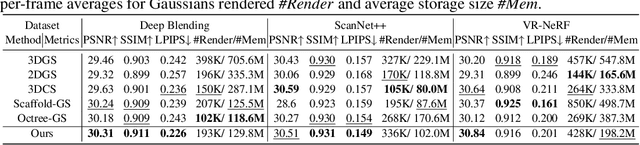
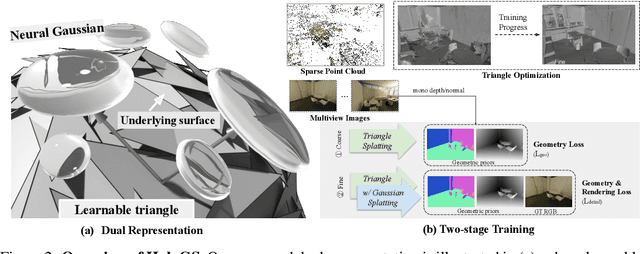
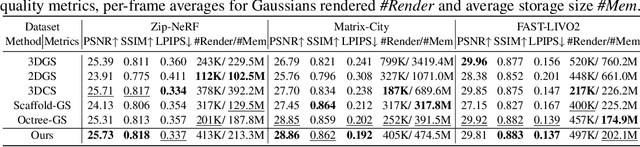
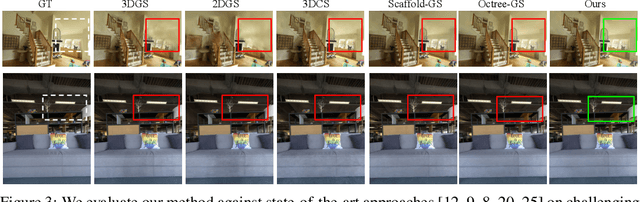
High fidelity 3D reconstruction and rendering hinge on capturing precise geometry while preserving photo realistic detail. Most existing methods either fuse these goals into a single cumbersome model or adopt hybrid schemes whose uniform primitives lead to a trade off between efficiency and fidelity. In this paper, we introduce HaloGS, a dual representation that loosely couples coarse triangles for geometry with Gaussian primitives for appearance, motivated by the lightweight classic geometry representations and their proven efficiency in real world applications. Our design yields a compact yet expressive model capable of photo realistic rendering across both indoor and outdoor environments, seamlessly adapting to varying levels of scene complexity. Experiments on multiple benchmark datasets demonstrate that our method yields both compact, accurate geometry and high fidelity renderings, especially in challenging scenarios where robust geometric structure make a clear difference.
Overview of AI-Debater 2023: The Challenges of Argument Generation Tasks
Jul 24, 2024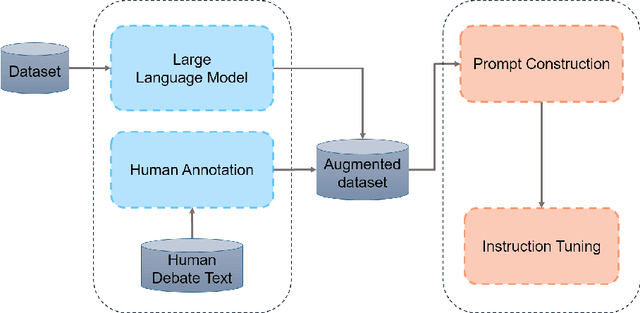
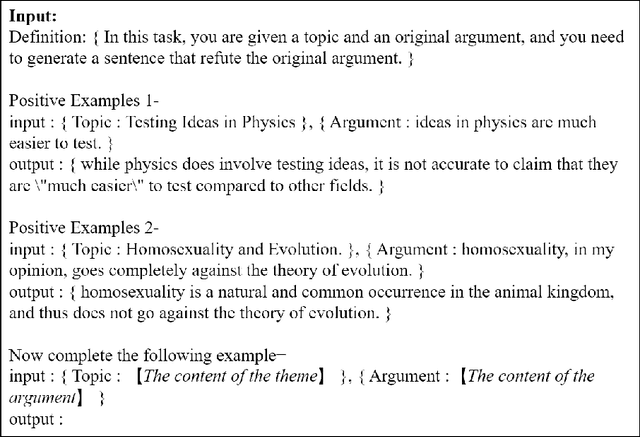
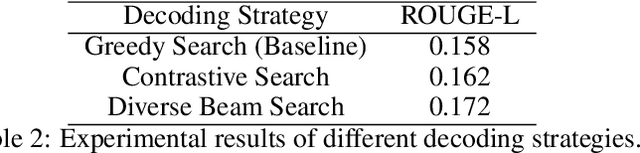
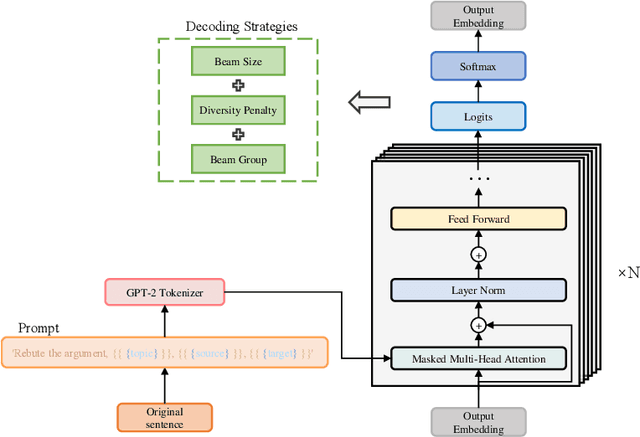
In this paper we present the results of the AI-Debater 2023 Challenge held by the Chinese Conference on Affect Computing (CCAC 2023), and introduce the related datasets. We organize two tracks to handle the argumentative generation tasks in different scenarios, namely, Counter-Argument Generation (Track 1) and Claim-based Argument Generation (Track 2). Each track is equipped with its distinct dataset and baseline model respectively. In total, 32 competing teams register for the challenge, from which we received 11 successful submissions. In this paper, we will present the results of the challenge and a summary of the systems, highlighting commonalities and innovations among participating systems. Datasets and baseline models of the AI-Debater 2023 Challenge have been already released and can be accessed through the official website of the challenge.